Indonesia · City guide

Jakarta

Jakarta’s international schools are some of Asia’s oldest — JIS dates to 1950 — and some of its most misunderstood. No school here may legally call itself “international”; they are SPK collaboration units run as non-profit foundations. Fees at the top rival Singapore. And the city’s traffic makes school choice and home choice the same decision.

The frame

SPK licences, yayasan foundations — the rules that shape everything

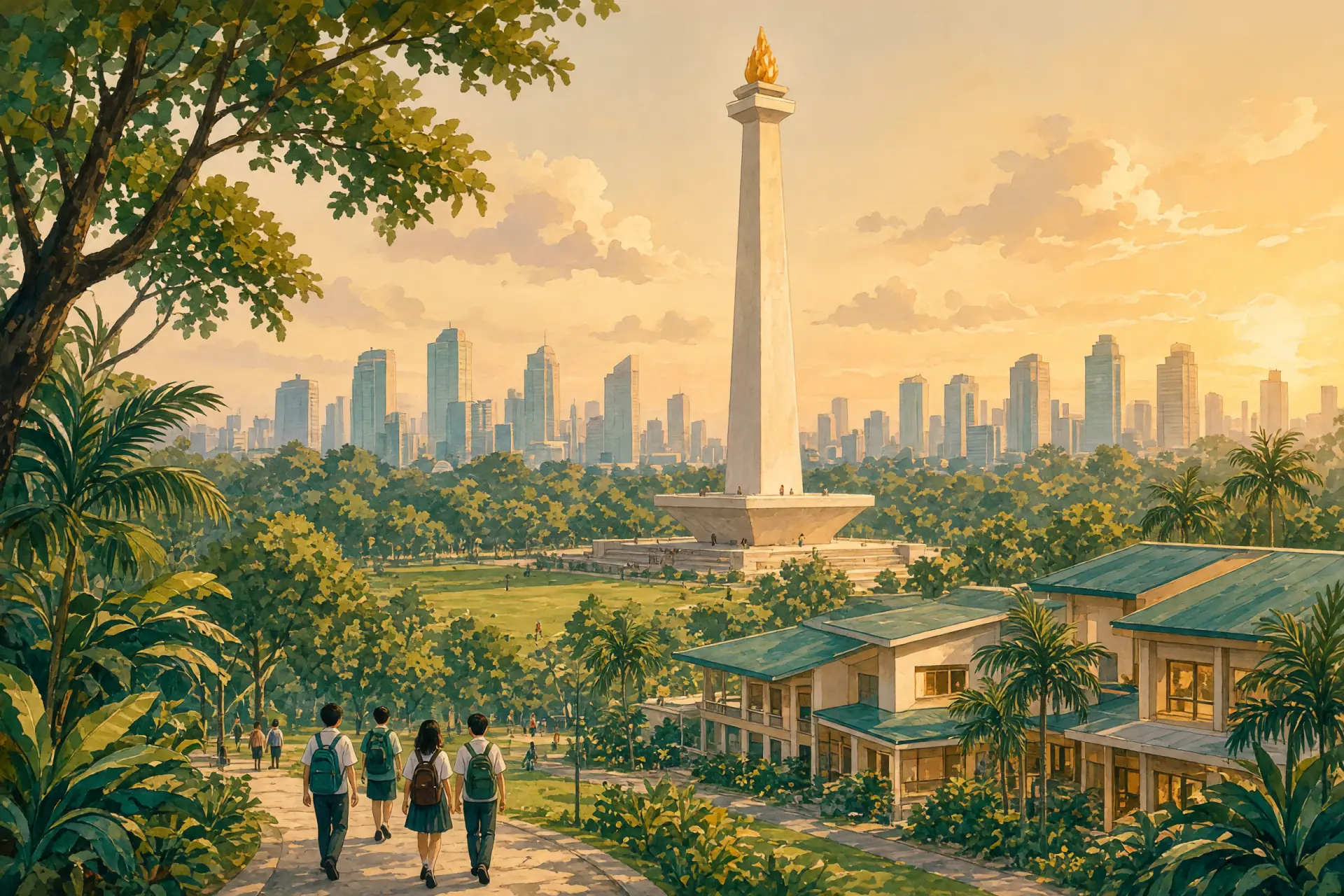
Illustration of Jakarta's national monument and skyline with a lush international school campus in the foreground

No school in Indonesia may legally call itself “international”. Under Ministry of Education and Culture Regulation 31/2014, every international and “national plus” school became an SPK — Satuan Pendidikan Kerjasama, a “collaborative education unit” — by 31 December 2014. Independent international schools are prohibited; each SPK must operate in partnership with a domestic institution or an accredited foreign education authority, and the word “international” is banned from names, programmes and classes. That is why the market’s flagships are called Jakarta Intercultural School and British School Jakarta.

The rules have classroom consequences. SPK schools must teach Indonesian civics, religion and Bahasa Indonesia; Indonesian-citizen students sit national examinations at Grades 9 and 12 alongside their international assessments (foreign students are exempt); foreign educators are capped at 70 per cent of the teaching staff. The Indonesian SPK School Association counted 425 member schools within a year of the framework — today there are over 500 SPK schools nationwide, the largest concentration in Jakarta.

Ownership is non-profit — on paper. Indonesian schools operate as yayasan (foundations), legally barred from distributing profit. German School Jakarta makes the case that this keeps fees honest: tuition funds education, not shareholders. Parents should know the nuance — some foundations are closely tied to operating companies, and fee trajectories vary widely between foundation-run schools. The oldest names are genuine institutions: JIS (1950, American), Gandhi Memorial (1951, British), Deutsche Schule Jakarta (1957) and the Japanese School (1978).

The flagship

JIS: three campuses, one very large invoice

Jakarta Intercultural School is the market’s centre of gravity: three campuses — Pattimura Elementary, Pondok Indah Elementary, and the Cilandak middle/high school — across 20 hectares, teaching more than 2,300 students from 70+ nationalities on an American-IB programme. It is the default for US embassy and senior corporate families, and the price setter for the market.

JIS’s published fee structure has four layers. The enrolment fee is IDR 22,000,000 a year if paid by 19 April (IDR 27,000,000 after). The capital fee is IDR 56,000,000 a year. Tuition runs IDR 350,500,000 (kindergarten), IDR 369,800,000 (Grades 1-5), IDR 432,000,000 (Grades 6-8) and IDR 432,800,000 (Grades 9-12). An all-in high-school year: IDR 510,800,000 — roughly US$31,000-33,000 depending on the rupiah.

The extras are unusually structured too. Students assessed as needing English-as-an-Additional-Language support pay a one-time EAL fee of IDR 52,200,000 — and enrolment is conditional on joining the programme if JIS requires it. The school bus costs IDR 78,750,000 a year chaperoned (early years to Grade 5) or IDR 72,800,000 unchaperoned (secondary). Application fee: IDR 5,000,000. IB and AP exam fees, trips and graduation are invoiced separately. Model the full stack, not the tuition line.

The premium tier

British School Jakarta and the Bintaro question

British School Jakarta (BSJ) occupies an 18-hectare estate in Bintaro, technically over the city line in Tangerang — a purpose-built campus for ages 2-18 running the English curriculum through to the IB Diploma. Its published 2026/27 fees: IDR 158,518,000 in the early years (tuition IDR 135,268,000 plus a IDR 23,250,000 capital levy), IDR 449,504,000 for Grades 1-5, IDR 505,998,000 for Grades 6-10, and IDR 561,064,000 by Grade 12, plus a IDR 7,000,000 application fee.

The Bintaro location is the school’s defining trade-off. From Pondok Indah the peak-hour drive runs 45-60 minutes — manageable, and against the flow of traffic into the city — but families working in the Sudirman-SCBD corridor face a real daily journey. The answer many arrive at: live in Bintaro itself, where houses are larger and cheaper, and let one parent commute instead of the children.

Also in the premium conversation: Nord Anglia School Jakarta (Cilandak, British curriculum through IB) and The Independent School of Jakarta (Pondok Indah, English National Curriculum for ages 2-13) — ISJ’s own market guide prices the tier honestly: JIS at IDR 305-633M, BSJ at IDR 159-561M, itself at IDR 149-505M a year depending on year group.

The mid-tier

Where the value actually is

Jakarta’s mid-tier is deeper than most guides admit — several schools deliver accredited IB or Cambridge pathways at half the flagship price:

  • Global Jaya School (Bintaro, founded 1995) — full IB continuum, WASC-accredited, about 800 students. Published 2026/27 fees: IDR 82,302,000-222,844,000.
  • Australian Independent School (AIS) — founded 1996, primary campus in Kemang; Australian Curriculum to Year 10 then IB Diploma. CIS-accredited (November 2024), with a relaxed community parents contrast with the flagships’ formality.
  • ACG School Jakarta — South Jakarta (Pasar Minggu), about 300 students, IB PYP then Cambridge IGCSE then IB Diploma; noted for strong English-language support for transitioning students.
  • The national-plus layer — Mentari Intercultural School (IDR 65-175M), HighScope Indonesia (IDR 50-180M), BINUS, SPH and Gandhi Memorial serve a largely Indonesian student body with bilingual or Cambridge/IB tracks at budget-to-mid prices. For families on local packages they are the rational choice; the student-body mix and English depth differ from the premium tier.

Deutsche Schule Jakarta and Lycée Français de Jakarta serve their national communities on foundation models; both are worth a call for German- and French-speaking families, though neither publishes an English-language fee schedule.

Admissions

Twelve-to-eighteen-month waits — and how to work around them

At the premium SPK schools, nursery and early-primary waiting lists run 12-18 months ahead of the entry date, per Expat Focus’s Indonesia guide. Senior-year places are easier; the crunch is at the bottom of the school. Families finalising a Jakarta posting should file applications before the move is confirmed — JIS’s 19 April enrolment-fee deadline effectively sets the rhythm of the whole market.

Assessments are standard: English, reading, writing and maths at JIS; English-proficiency testing across the British and IB schools. Mid-year entry is routine — Jakarta’s expat churn opens places through the year, and the mid-tier schools absorb families while flagship waitlists move. The school year runs August to June at the international schools, so northern-hemisphere transfers arrive cleanly.

Neighbourhoods

Five kilometres, forty-five minutes: the traffic equation

School and home are one decision here. Jakarta’s expat-family corridor is South Jakarta: Pondok Indah (gated, insulated, walkable to JIS and the mall), Kemang (cosmopolitan, restaurant-dense, served by most school bus routes — but flood-prone), Cipete (quieter, in between) and Cilandak (JIS’s secondary campus, Nord Anglia). A 5 km journey at the wrong hour takes 45 minutes; families regularly move house after one term of a badly chosen school run.

The alternatives each have a school logic: Bintaro/BSD City for BSJ and Global Jaya families who want space; Kelapa Gading and PIK in the north for NJIS and SIS families tied to the port and industrial east — a separate world from the southern corridor. Central Jakarta (Menteng, SCBD) suits professionals without school-age children; those with them end up busing south daily.

Safety texture from ISJ’s 2026 briefing, attributed as reported experience: Pondok Indah reads as the most insulated address in the city; Kemang floods badly in heavy rain and sees more night-time opportunistic crime around the strip. Choose the micro-location with the same care as the school.

Sources

Where the numbers on this page come from

Every fee figure and policy claim above traces to our research dossier. Primary sources: the SPK regulatory framework, German School Jakarta on yayasan governance, and school-published schedules. JIS’s fee stack is cited from its published schedule as reproduced by Edarabia (medium confidence — confirm against the school’s current PDF); BSJ and Global Jaya figures come from the International Schools Database’s 2026/27 records; market-level ranges come from ISJ’s published comparison. Where schools do not publish fees in English (Nord Anglia Jakarta, Deutsche Schule, Lycée Français), we say so rather than guess.

Fees and policies expire. This page was researched on 2 September 2026 and is re-verified each academic year — see our research standard for how claims are graded, and corrections if you spot something stale. Families weighing an island move should also read our Bali guide.

Coverage priorities

What we investigate here

01

The regulatory frame: the SPK licence, the banned word “international”, and what yayasan foundation governance means for your fees.

02

JIS in detail: three campuses, the published fee stack — tuition, enrolment fee, capital fee, EAL charge, bus — and what an all-in year costs.

03

British School Jakarta and the premium tier: BSJ’s Bintaro campus, Nord Anglia and the newer British entrants.

04

The mid-tier: Global Jaya, ACG, AIS, Mentari and the national-plus schools most guides ignore.

05

Admissions: 12-18 month waits at the premium schools, assessment mechanics, and mid-year reality.

06

Neighbourhoods: Pondok Indah, Kemang, Cilandak, Bintaro and Kelapa Gading — school run as lifestyle choice.

Research in progress

We publish clusters, not placeholders.

This city opens in full when its first connected group of school profiles, fee explainers, and admissions guidance has passed our evidence and editorial gates.

Read our publication standard →