Qatar · City guide

Doha

Doha is the Gulf’s second-largest international-school market — more than three hundred private schools, a dominant British sector, and a regulator that has just rewritten the rules on school fees. Choice is real; so is the competition for places at the handful of schools every expat family shortlists first.

The landscape

What every relocating family should know first

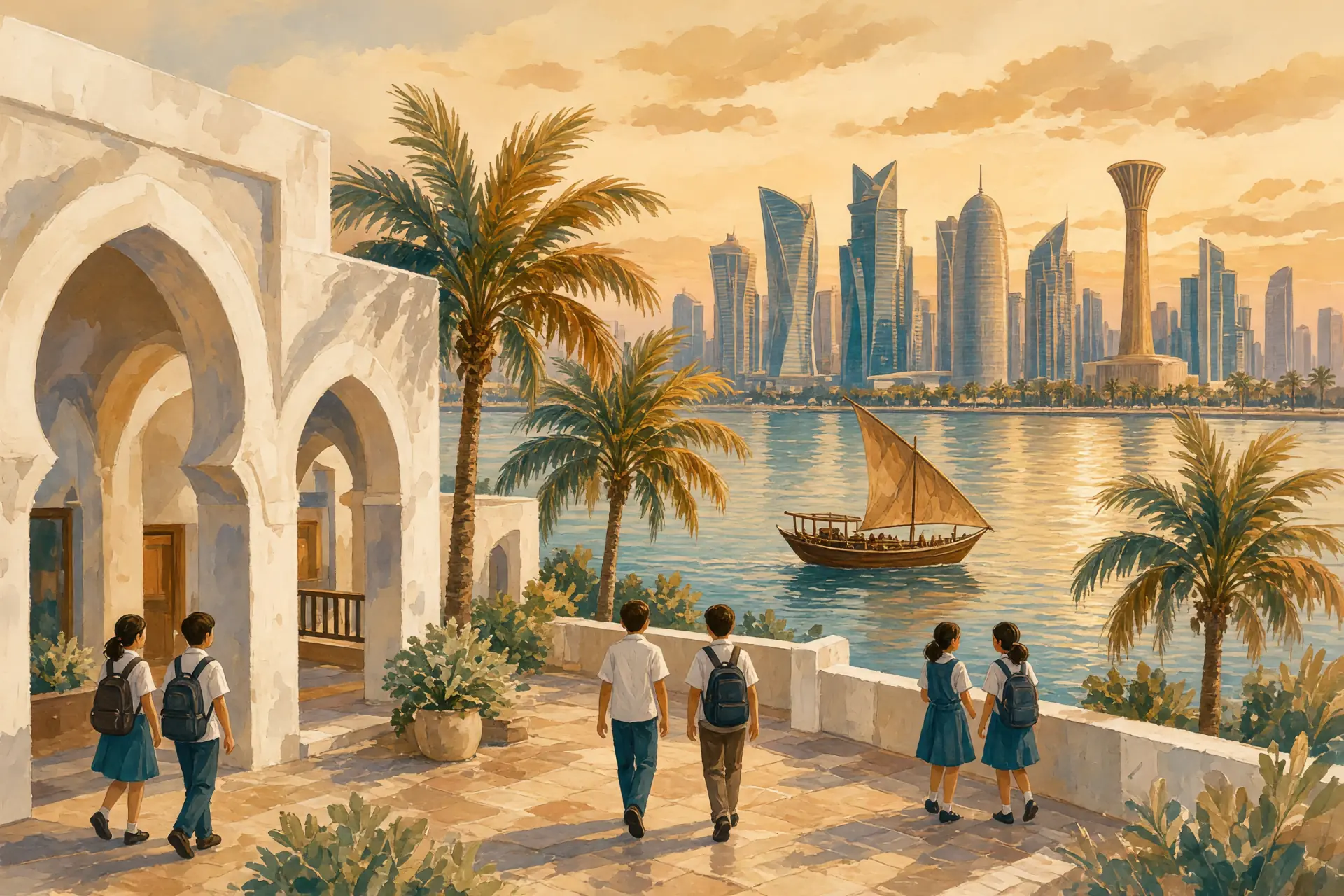
Illustration of the Doha West Bay skyline across the bay with an international school courtyard in the foreground

Private schooling is where expat children go — full stop. Qatar’s government schools teach in Arabic and prioritise citizens; private schools educated 209,088 students across 334 schools in 2022, including roughly 72% of non-Qatari children. Around 338 private and international schools operate today, the large majority in and around Doha, and British-curriculum schools account for roughly 44% of the private K-12 market.

The regulator holds real power. Under Law No. 23 of 2015, the Ministry of Education and Higher Education (MOEHE) licenses every private school, approves curricula and teacher appointments, and — critically — approves every fee. A school cannot raise its fees without Ministry sign-off, and since June 2026 the rules around that process have become much more parent-friendly (see below).

Qataris are part of the market too. A government voucher worth QAR 28,000 helps Qatari families pay private-school tuition — more than 24,000 students used it in 2021/22 — which means the “international” schools you tour are genuinely mixed communities, not expat bubbles.

The regulator

The School Fees Policy 2026 — read this before you budget

In June 2026 MOEHE launched Qatar’s first unified School Fees Policy, covering all 355 private schools and kindergartens. Three provisions matter to a relocating family:

  • 18 months’ notice. From the 2027–28 academic year, any approved tuition increase reaches your invoice no sooner than a year and a half after approval — time to plan, or to move schools.
  • A cap, and a spread. Increases are capped, must be justified on academic, operational and financial criteria, and any approval above 5% must be spread across two consecutive years.
  • Standardised fee schedules. The Ministry is issuing standardised fee schedules for every private school — ask for the Ministry-approved schedule, not the marketing PDF.

The pilot cycle shows the Ministry means it: of 99 schools that applied to raise fees for 2026–27, only 54 were approved and 22 were rejected outright. Before this policy, increases often landed weeks before term started.

The fee reality

Named schools, real numbers

Doha’s spread is wide: roughly QAR 6,000–18,000 a year at Indian-curriculum community schools, the low-QAR 20,000s to mid-70,000s at British schools, and QAR 35,000–80,000 at American schools, with capital charges pushing some premium totals above QAR 85,000. Published figures we verified:

  • Doha College (British, Al Wajba and West Bay, not-for-profit): 2026–27 tuition is QR 13,717 per term in Years 1–6 (≈ QAR 41,151/year) rising to QR 24,947 per term in sixth form (≈ QAR 74,841/year), plus an annual capital charge of QAR 8,000 in primary and QAR 5,000 in secondary. Registration QAR 3,650; exam fees extra in Years 10–13.
  • Doha English Speaking School (DESS) (British primary, Fereej Kulaib, ages 3–13, not-for-profit): QAR 38,120 a year from FS1 to Year 6 in 2025/26, QAR 49,500 by Year 8, plus a QAR 2,750 registration fee. The most-loved — and hardest to enter — British primary in the city.
  • American School of Doha (American/IB, Al Waab): 2025/26 kindergarten totals QAR 47,520 including the QAR 10,950 annual capital fee; Grades 6–12 run to QAR 93,905 all-in.
  • ACS Doha (American/IB): 2025/26 tuition QAR 51,309 (Pre-K/KG) to QAR 80,465 (Grades 7–12), plus a QAR 5,352 annual capital charge.
  • Compass International School Doha (Nord Anglia, British/IB, three campuses): 2025/26 tuition QAR 45,000 (Early Years 1) to QAR 68,342 (secondary), plus an annual resources fee around QAR 3,900.
  • Sherborne Qatar, King’s College Doha, Qatar International School, Park House English School, Swiss International School Qatar: published ranges run from QAR 22,934 (Park House entry years) to about QAR 74,071 (Swiss International’s senior IB years); King’s KG1 year totals QAR 47,550. Verify each school’s current Ministry-approved schedule — third-party figures age fast.

Admissions

The calendar has ministry fingerprints on it

Mid-year moves are regulated, not just discouraged. Under Ministry admissions guidelines — which schools must follow — registration for in-Qatar transfers closes on 15 October; after that, changing schools requires Ministry permission. Overseas applications typically close at the end of January for the following September, and year-group placement follows a strict age cut-off (31 August at British-curriculum schools).

Offers are secured by invoices, not emails. At DESS, for example, an offered place is held only once the invoice for a term’s fees plus registration is paid by its due date; the QAR 2,000 seat reservation fee is due each year to keep a place for autumn. Diarise the term due dates (late August, early January, late March) — losing a hard-won place to a missed invoice is a real failure mode.

British primary is the pinch point. Parents have reported multi-year waits at the small set of established British primaries — DESS above all — and heads have publicly linked the shortage to companies’ ability to recruit families. The reporting is dated and we could not verify current list lengths, but the structural advice from every parent forum is identical: apply from abroad, as early as the school allows, to more than one school.

A different beast

Education City and the Qatar Foundation schools

Qatar Foundation’s pre-university network — anchored by the Qatar Academy IB schools (flagship Qatar Academy Doha has 1,900+ students), plus specialist schools like Awsaj Academy (learning support), Renad Academy (autism) and the STEM-focused Qatar Academy for Science and Technology — sits inside Education City alongside the branch-campus universities. It is not part of the commercial market: admissions run through a published priority policy that ranks Qatar Foundation staff children, Qatari siblings and Qatari applicants ahead of non-Qatari public applicants while maintaining nationality balances.

The practical read: excellent IB continuum schools, but an expat family without a Qatar Foundation employer should treat a Qatar Academy place as a bonus, not a plan.

Packages and extras

The allowance question, and what tuition omits

Negotiate the allowance before you sign. Education allowances are a standard feature of Qatar packages in energy, finance and professional services — but the amount, the number of children covered, and whether capital charges count vary enormously and are rarely published. Get the figure in writing and test it against the all-in cost, not headline tuition.

The extras are meaningful. Budget beyond tuition for application and assessment fees (a few hundred to over QAR 1,000), registration or seat-confirmation charges (QAR 2,000–4,000+), mandatory annual capital or development charges at premium schools (QAR 5,000–11,000), school transport, uniforms, devices, and external exam fees in IGCSE, A-level and IB years. The Ministry’s new standardised schedules should make these easier to compare — ask for the full schedule every time.

Neighbourhoods

Where schools sit, and how the run works

West Bay and the Pearl suit the northern schools and Qatar International School’s catchment; Al Waab and the E-Ring corridor hold the American School of Doha and several British schools; Education City anchors the west side near Al Rayyan; and Lusail’s newer communities are drawing new campuses north. Traffic is the honest constraint: a 7:15 start from the Pearl to Al Waab is a different family life than the reverse commute. Most premium schools run bus networks, billed separately — confirm your tower or compound is on a route before you sign a lease.

Comparing postings across the Gulf? See our Dubai and Manama guides — the three markets price and regulate very differently. Our school directory lists every profile that has passed our evidence gates, and the guides hub covers curriculum choice and admissions strategy in depth.

Coverage priorities

What we investigate here

01

The MOEHE landscape: how Qatar licenses private schools, and what the June 2026 School Fees Policy — 18 months’ notice before any approved increase — changes for family budgets.

02

The fee reality: named schools with published numbers, from Doha College’s capital charge to the Indian-curriculum community schools a fraction of the price.

03

Waitlists and timing: Qatar’s ministry-controlled transfer windows, the overseas-application calendar, and why British primary places are the pinch point.

04

The Education City factor: Qatar Foundation’s Qatar Academy network runs its own admissions priority system — a different beast from the commercial market.

05

Packages and neighbourhoods: education allowances in Qatar offers, and how West Bay, Al Waab, the Pearl and Lusail shape the school run.

Research in progress

We publish clusters, not placeholders.

This city opens in full when its first connected group of school profiles, fee explainers, and admissions guidance has passed our evidence and editorial gates.

Read our publication standard →